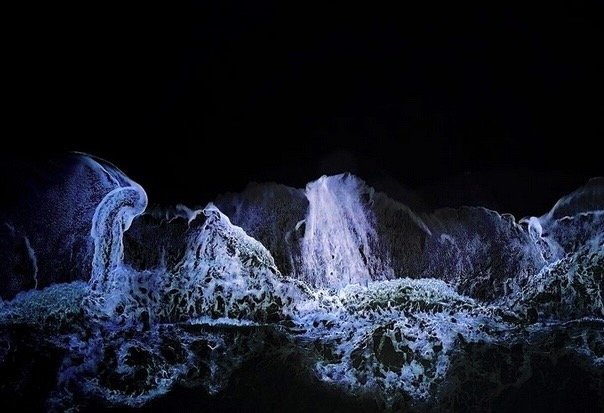
Adam Sebire, Tideline 2018 Duration: 2'30" / 4K single-channel, stereo audio
Terra Incognita: Beckett’s Anthropo(s)cene in Contemporary Art’, Beckett and Ecology, eds. Trish McTighe, Céline Thobois-Gupta, Nicholas E. Johnson (London: Methuen Drama 2025), pp.113-123
Beckett’s critical posthumanism is marked by an increasing engagement with embodied interrelations between the human and its environment, which includes the vascular and neurological environment which makes possible our concepts and actions, and the climatic, affective environment in which others engage with those concepts and actions. Beckett’s play Breath can be viewed as an attenuated response to the anthropocenic environment in which, to quote Endgame, allis ‘corpsed’. Environmental scientists Will Steffen, Paul Crutzen, and John McNeill use the term ‘Anthropocene’ to mark how ‘human activities have become so pervasive and profound that they rival the great forces of Nature and are pushing the Earth into planetary terra incognita’ (Steffen, Crutzen, and McNeill 2007, 614). Through readings of Beckett’s Breath and Embers, in conjunction with the work of four artists –Barbara Knesevic’s installation Breath, Roni Horn’s installation Library of Water, Adam Sébire’s three-part video series Anthropo(s)cene(s); and Justin Guarigalia’s photographic project After Nature – the chapter argues that the posthuman concerns of the anthropocene are integral to 21st century readings of Beckett. In these artists’ work this limit is articulated as a topographical extreme which challenges the extent of human control, evoking the topos of Beckett’s Breath and Embers to articulate a position that ‘contests’ as Rosi Braidotti puts it, ‘the arrogance of anthropocentrism’ and leads us, through readings of Donna Haraway, to consider a polis of kinship across species and environments.
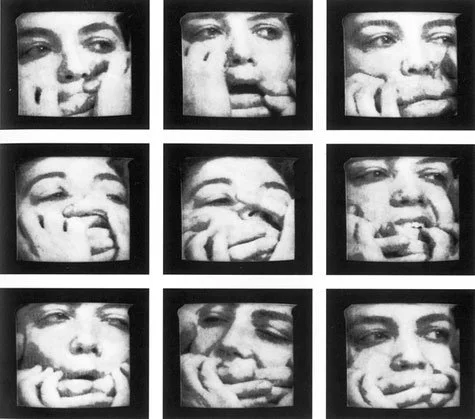
Mona Hatoum, So Much I Want To Say 1983, duration 5mins, B&W, mono audio.
‘'Toward a Politics of Vocal Expression: Beckett and Video Art', Journal of Beckett Studies: Beckett and Contemporary Aesthetic form, eds. Conor Carville and Pim Verhulst. 34:1 (2025), pp. 48-64
By exploring modalities of asynchronicity, slippage, awkwardness, and obstruction through the philosophies of Adriana Cavarero and Hannah Arendt – who argue that speaking up is a deeply political act – the article positions Not I within an ethics of voice.This article examines the televisual version of Beckett’s play Not I (1973) as a work of video art, placing it in dialogue with video work by Bruce Nauman (Lip Sync, 1969), Vito Acconci (Open Book, 1974), Gary Hill (Mouth Piece, 1978), Stan Douglas (Deux Devises: Mime, 1983), and Mona Hatoum (So Much I Want to Say, 1983), with reference also to Agnieszka Polska (I Am The Mouth, 2014), and Kurdwin Ayub (Pretty-Pretty, 2015).
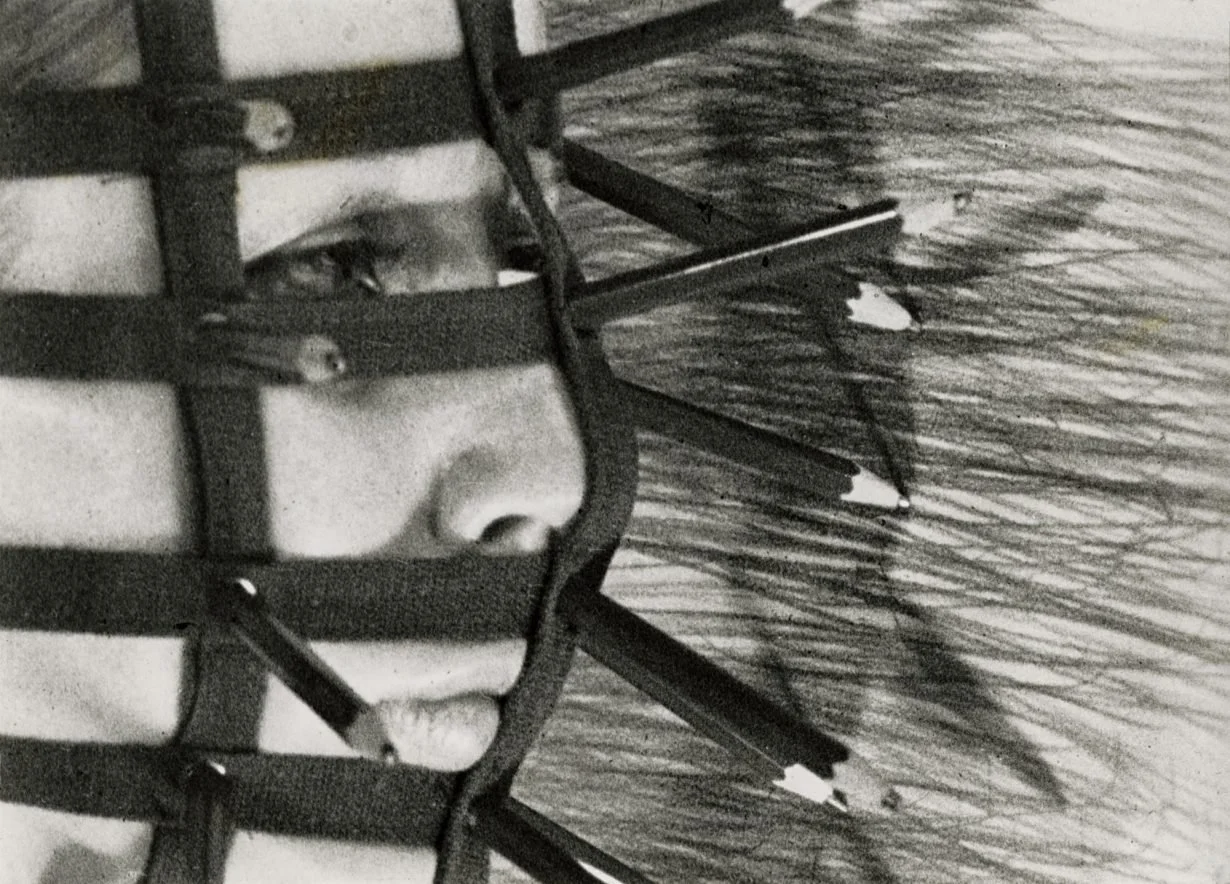
Rebecca Horn Pencil Mask 1972 Archive Rebecca Horn. Medium: Fabric, pencils and metal. Dimensions: Object within display case: 650 x 520 x 400mm.
‘Beckett, Neurodiversity and the Prosthetic: the Posthuman Turn in Contemporary Art’, Beckett’s Afterlives: Adaptation, Remediation, Appropriation, eds. Jonathan Bignell, Pim Verhulst and Anna McMullan (Manchester: Manchester University Press, 2023), pp.126-139
The chapter argues that the posthuman in Beckett provides the most fertile ground for intermedial adaptation of his work in the contemporary arts. It analyses examples of how selected contemporary artists in different media draw on Beckett’s work in order to expand and explore normative categories of human embodiment and subjectivity, such as the interface between the machinic, the prosthetic and the corporeal in work by Rebecca Horn (1970s–2010s), and neurodiverse theatre performance that reconfigures modalities of subjectivity and agency in Jess Thom’s Touretteshero production of Not I (2017). The chapter draws into the discussion an exploration of how ideas of silence, recalibrated by neurodiversity, are rendered somatic through Anne Niemetz’s and Andrew Pelling’s sound work Dark Side of the Cell (2004).